The James Webb Space Telescope, NASA’s premier observatory, is scheduled for launch December 18 from French Guiana. The worlds most powerful space observatory will take a unique look into our solar system, discover and observe new exoplanets, and look deeper into our known universe than ever before.
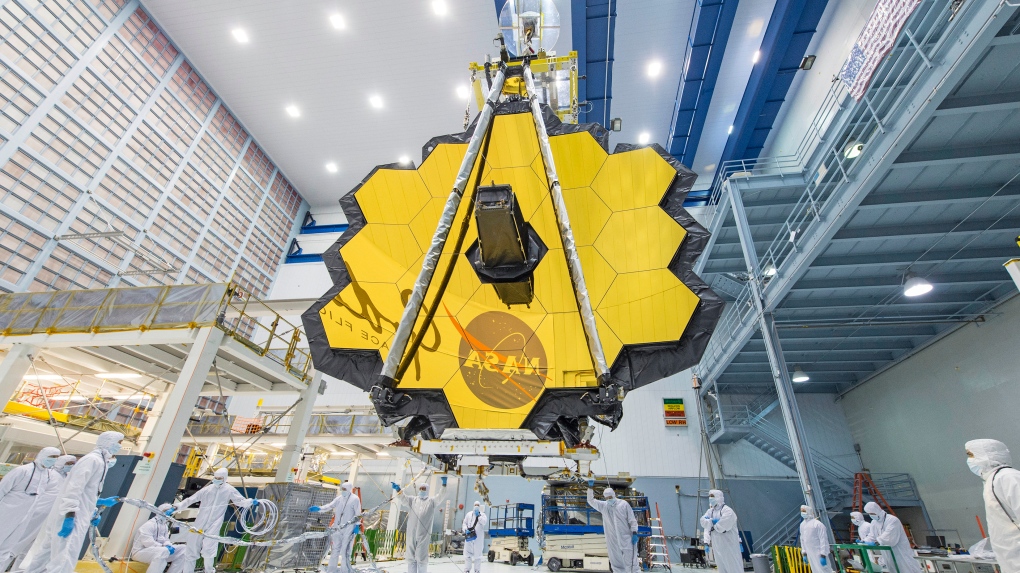
The telescope is equipped with a mirror that can extend over 6 meters, allowing it to collect more light and more detail from the objects that it observes. The mirror includes 18 hexagonal gold-coated segments, each 1.32 meters in diameter. It’s the largest mirror NASA has ever built. The technology in the new Webb space observatory allows for much higher resolution and sensitivity than the Hubble telescope. In addition, Webb will act as an infrared detective, seeing light in wavelengths that is otherwise hidden.
What Will Webb See?
The Webb telescope will look at cosmic history, from the big bang and formation of the galaxies, stars and planets to the current state of our own solar system. The science goals for Webb are ambitious, and scientists around the world will use their time with Webb to observe and analyze a broad spectrum of planets, black holes, galaxies, stars and the structure of the universe itself. A key focus is planet formation and evolution, both in our solar system as well as the large population of planets outside of it.
What Can It Do?
With all of its superlatives, engineering Webb was an extraordinary challenge. The observatory is comprised of three main elements.
1) Integrated Science Instrument Module, which holds Webb’s suite of four instruments. These instruments will mainly be used for capturing images or spectroscopy — breaking down light into different wavelengths to determine physical and chemical components.
2) The Optical Telescope Element, the main eye of the observatory, includes the mirrors and backplane, or spine, that supports the mirrors.
3) The Spacecraft Element, which includes spacecraft thrusting and sun-shield. The spacecraft includes the six main subsystems needed to operate the spacecraft, including propulsion, electrical power, communication, data and thermal controls. The five-layer sun-shield unfurls to reach the size of a tennis court and it will protect Webb’s giant mirror and instruments from the sun’s heat because they need to be kept at a very frigid negative 370 degrees Fahrenheit to operate.
When to expect the first images
The agency has referred to it as “29 days on the edge.” After launching, the observatory will travel for about a month until it reaches an orbit about 1 million miles away from Earth. During those 29 days, Webb will unfold its mirrors and sun-shield. Then it will begin to collect the data. The first images are expected later in 2022. Thousands of scientists around the world have been waiting to see what Webb can teach us.
Sources
Ashley Strickland CNNhttps://www.google.com/amp/s/amp.cnn.com/cnn/2021/11/15/world/james-webb-space-telescope-explainer-scn/index.html
Dr. Caitlin M. Casey Univ. of Texashttps://www.google.com/amp/s/www.texasmonthly.com/news-politics/texas-astronomer-webb-telescope/amp/
Elizabeth Howell Space.comhttps://www.google.com/amp/s/www.space.com/amp/nasa-james-webb-space-telescope-launch-one-month
 Exploring Science
Super cool, Jack! Love the website too. Thanks for keeping me updated on science because normally I’d have no clue 🙂
Aunt Natalie
Sent from my iPad
>
LikeLike