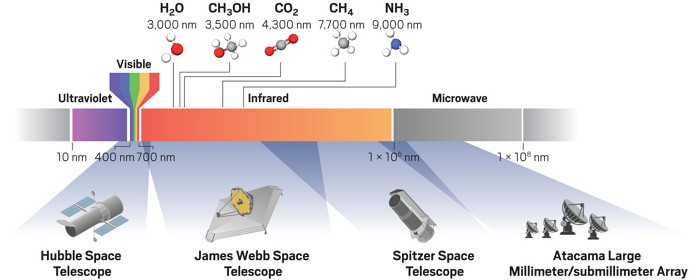
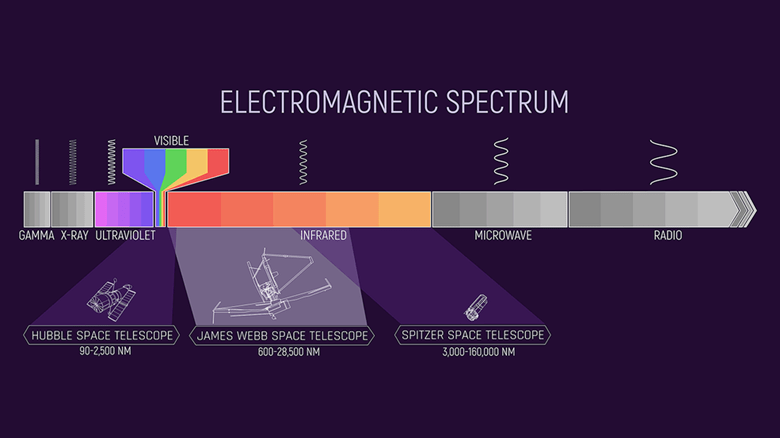
The James Webb Telescope is readying for a universal chemistry experiment. Once operational, Webb will split the light from targets that it observes into spectra, which measures the amount of light within specific electromagnetic wavelengths. This information will shed light on mass, temperature and chemical compositions of galaxies and exoplanets.
With NIRSpec, James Webb can collect spectra of up to 100 galaxies simultaneously, making observations very efficient when one considers that collecting light photons from such distantces can take hundreds of hours.
According to the Webb Blog Post, NIRSpec’s three key mechanisms are 1) a filter wheel assembly, 2) a grating wheel assembly and 3) a refocus mechanism assembly. Here is how the instrument will work. The grating wheel spreads light from a target of interest into its wavelengths to create a spectrum. The filter wheel reduce the contamination by blocking wavelengths outside of what scientists are interested in. The refocus mechanism will then adjust and sharpen NIRSpec’s focus.
Engineers reviewed each assembly separately, starting with the filter wheel to make certain its eight positions in forward and reverse directions were working.
“At each position, we recorded a set of reference data,” Webb officials wrote. “This data showed us how well the wheel was moving, and how accurately it settled into each position. Between each … position, we downloaded ‘high-capacity buffer’ data from the positioning sensors, and the NIRSpec team analyzed the data. The data showed that the wheel moved very well even in the first attempt.” Next, Webb engineers recorded the reference data of the grating wheel assembly and cycled the positions in much the same way, showing that everything was working correctly.
Then with the refocus mechanism assembly (RMA), engineers also did an initial data collection before commanding the mechanism to move forward “a few hundred steps from launch position,” the blog post said.
Sources:
https://www.space.com/james-webb-space-telescope-universe-chemistry-instrument
 Exploring Science