NASA’s James Webb Space Telescope has reached its final orbital destination. It is an orbital place in space referred to as “L2,” or the “Second Lagrange Point.” If all goes well the most sophisticated space observatory ever built will spend 20 years or more peering into deep space, providing us with an unprecedented look into our universe.
JWST (James Web Space Telescope) fired its stabilizing thrusters to position itself at L2 on January 24, 2022. JWST is positioned about 1.5 million KM from Earth (about 4 times the distance to the moon), situated on the opposite side from the Sun. It will orbit the Earth approximately every 6 months. There, the combined gravitational pull of the Earth and Sun will balance the force that pulls Webb in the opposite direction.
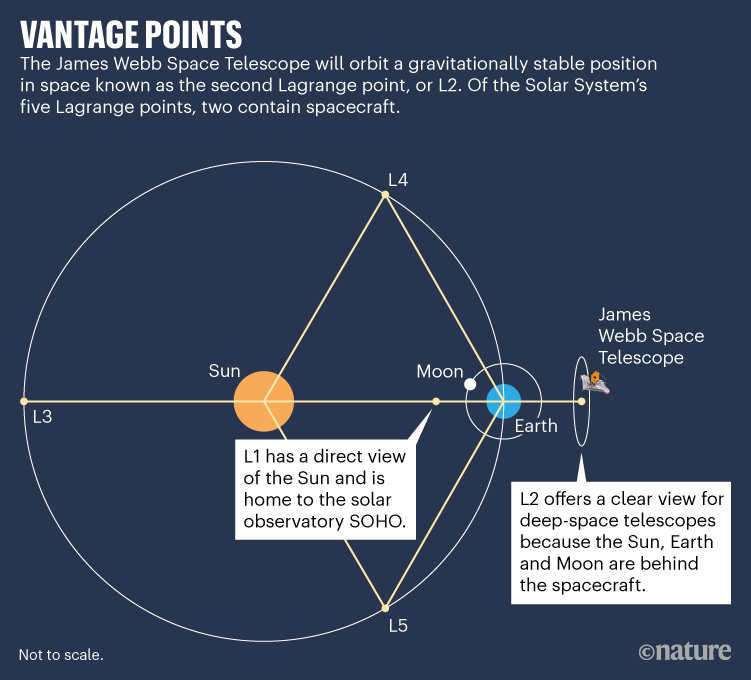
Photo Courtesy of Nature Magazine
Cold Is Good!
L2 is an important orbital position, mainly because it is so cold. Earth-orbiting missions go in and out of sunlight on each orbit, experiencing huge temperature swings. Scientific instruments that have to remain extremely cold to function do better at L2, where the temperature is cold and stable. JWST’s instruments operate at temperatures of about –233 °C, or approximately 40 degrees above absolute zero.
The Lagrange points are named after Joseph-Louis Lagrange, who in 1772 discovered these points as places where a body can maintain position in coordination with two larger bodies.
More on Lagrange Point:
Thrust and burn
We never actually get to L2 but we can get very near it. JWST travels on an eliptical path with a semimajor axis (the maximum distance between the spacecraft and L2) that ranges between 250,000 and 832,000 km. Webb does not pass into the Moon’s shadow, allowing its solar panels to remain charged and its antennas to communicate constantly with Earth. To remain in orbit, JWST will require a series of small burns weekly to keep it from drifting into deep space.
NASA has been studying ways to keep L2 missions operating beyond their planned lifetimes. JWST could theoretically dock with a robotic spacecraft to refuel and resupply. Future planned missions to L2 include NASA’s Nancy Grace Roman Space Telescope, scheduled to launch in 2027, and ESA’s planet-hunting Plato and Ariel missions, slated for launch in 2026 and 2029.
Webb is a collaboration between NASA, ESA and the Canadian Space Agency
Sources:
 Exploring Science